
Voices For Justice in the 2026 Colorado Assembly
The Colorado Council of Churches’ (CCC) tagline, “Walking together in faith, working together for justice” succinctly describes the CCC’s ecumenical legislative advocacy, Voices For Justice (VFJ). Our state statutes can weave a strong fabric of justice for all people living in Colorado. To that end, the CCC, through the work of ten VFJ members, has been actively engaged in providing a faith-based perspective regarding bills introduced into the 2026 Colorado Assembly.
Guided by the nine CCC social policy statements, VFJ members supported bills that were congruent with these policy statements and opposed bills contrary to these policy statements. Oral and written testimonies were given to committees as they considered bills regarding children and youth in kinship care (HB26-1314), environmental care (SB26-016, SB26-028, SB26-065,) and care of our immigrant neighbors (SB26-005, HB26-1143, HB26-1276).
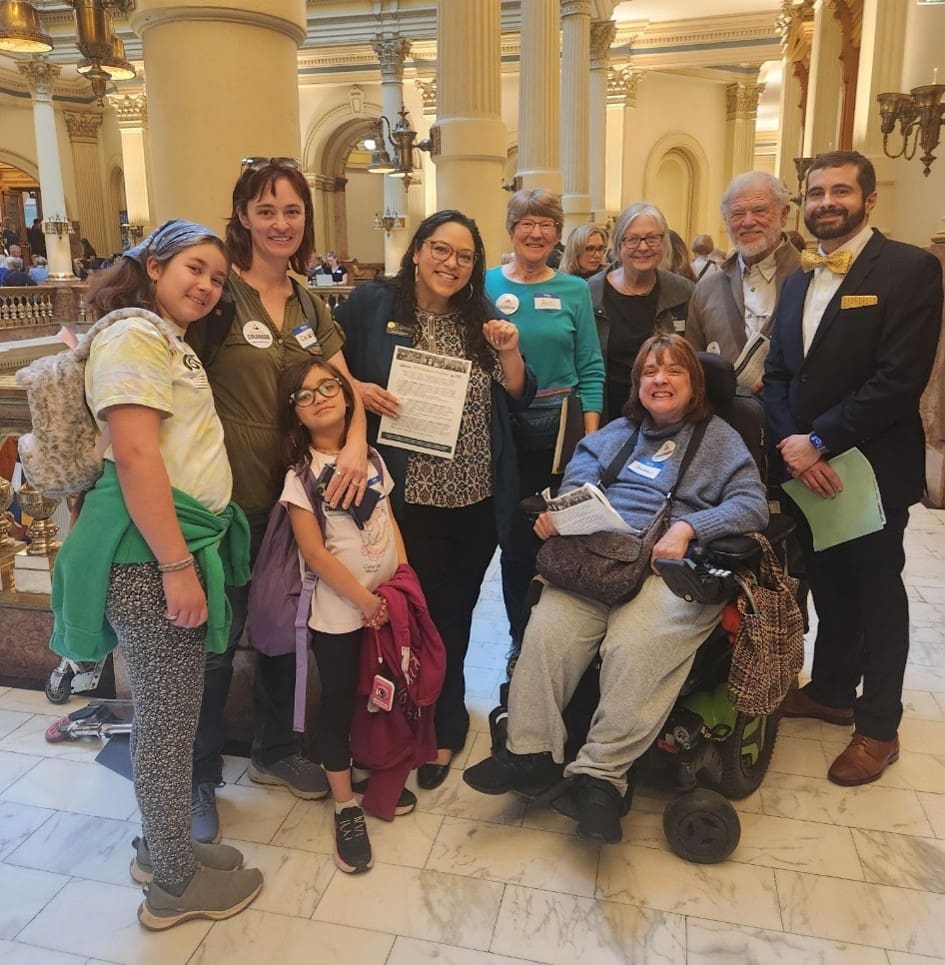
In March eight members of the VFJ team participated in Faith and Justice Lobby Day. Conversations with state representatives and senators or their staff included advocating for bills allowing solar balcony panels, energy cost support for low-income persons, guardrails on the use of data collected by traffic cameras and remedies in state courts for immigrants and other residents whose US constitutional rights are violated by federal authorities.
In addition to direct communication of VFJ members with state lawmakers, team members asked their church leaders and congregants to contact state senators and representatives regarding specific bills. Informing individuals in our networks about current bills and encouraging these folks to raise their voices continued to be an important role of the 2026 VFJ team.
Great fiscal constraint characterized the Assembly this year. Therefore, proposed laws that would require new costs to the Colorado General Fund had little chance of being passed by the Assembly. Also, a few bills supported by VFJ, but which failed to become laws, addressed quite complicated legal matters which provoked questions regarding legal authority of the federal and state governments and caution of potential lawsuits. Despite these restraining factors, in the summaries that follow you will learn of successes toward justice in nine areas of social concern: affordable housing; education of children; racism; poverty; environment; criminal and restorative justice; sexuality, families and abuse; health care and immigration. In addition, you will become aware of some potential policies that Colorado legislators might further pursue in revised bills in 2027.
Affordable Housing
Diane Ritzdorf
The VFJ midterm report included the passage of three bills supporting affordable housing:
- HB26-1001, Housing Developments on Qualified Properties, allows nonprofits such as school districts, state colleges and housing authorities to build affordable housing on land they own;
- SB26-001, Workforce Housing and Housing Tax Credit, allows a county to spend property tax revenue in its general fund for housing authorities and workplace housing; and
- HB26-1013, Ratio Utility Billing Systems, allows landlords to provide fair billing for renters’ utilities based upon a formula, allowing small rental units to have less utility cost than larger units.
During the last half of the legislative term several additional bills related to affordable housing became law:
- HB26-1045, Disabilities Housing Protection, provides definitions for different “assistance animals,” as applied to housing practices;
- HB26-1065, Transit and Housing Investment Zones, allows local government and transit agencies to work together to develop housing with money from state sales taxes;
- SB26-040, Affordable Home Ownership Program, allows the Division of Housing in the Department of Local Affairs to allocate money for affordable housing assistance;
- SB26-053, Colorado Housing and Finance Authority Mortgage POST Officers First Responders, makes peace officers and first responders eligible for grants through the Colorado Housing and Finance Authority.
- Through HB26-1224, Protections for Mobile Home Park Residents, needed protections were added to legislation passed in 2025 which allows mobile park tenants to work together to purchase their park property; and
- HB26-1313, Adjust Requirements Statewide Affordable Housing Fund, changes the methodology used to determine eligibility for affordable housing statewide from 3% to a target based on the annual job growth rate.
Overall, the Colorado Council of Churches experienced a productive year supporting legislation to provide, build and create affordable housing, especially for low-income persons.
Education of Children
Mary Ann Panarelli
This legislative session avoided cuts to core education funding commitments that have been made in recent years, despite the need to overcome the projected $1.5B budget shortfall. Overall education funding was increased to adjust for inflation, by $217.30 per student to an average state-wide base rate of $8908 (SB26-023, School Finance Act). This funding also continues the phase-in of the new per student funding formula that includes increased funding for rural schools and for schools with higher numbers of students living in poverty or requiring additional services due to disabilities or lack of English proficiency. This legislation goes beyond the past calculation that primarily provided additional funds based on the cost of living. Bipartisan passage of this bill reaffirms the commitment, even in these challenging budget times, to undo the damage to school budgets done by the Budget Stabilization Factor, which had previously allowed the legislature to transfer constitutionally mandated school funding to the general fund to fill budget shortfalls in other areas.
The final version of SB26-023 also included amendments to curtail the recent sharp increase in use and cost of funds awarded by Boards of Cooperative Services (BOCES). This funding provides for enrichment opportunities for homeschooled students and for students attending private schools, unless these opportunities are available within the public school district.
Recognizing the predicted budget shortfall over the next few years, the legislature passed SB26-135, State Public K-12 Education Funding, which places a funding referendum on the 2026 November ballot. The referendum would ask voters to reduce their tax refunds to provide additional funding for K-12 education, healthcare, and higher education.
Bills that were proposed but defeated in committee due to budget constraints included SB26-139 which would have provided financial assistance to districts to provide affordable housing for the education workforce, and HB26-1048 which proposed a state sales tax holiday on children’s clothing and school supplies for one weekend in July.
Racism
Adrian Miller
This session we monitored HB26–1141 which addresses discriminatory practices in public schools. As described in its final fiscal note, this bill expands the Colorado Anti-Discrimination Act’s definition of a discriminatory practice to include additional violations in schools, including institutions of higher education:
• excluding a student from participation in any educational programs or activities;
• denying a student the benefits of educational programs or activities;
• subjecting a student to discrimination in any educational programs or activities;
• treating a student differently from a similarly situated student; and,
• failing to take prompt and effective steps to eliminate a hostile environment
The bill also expands the definition of harassment in public schools to include any unwelcome or unwanted behavior on the basis of pregnancy or parental status.
Poverty
David Taussig
Following the strong themes in the Christian Scriptures to care for the poor, Colorado Council of Churches supports principles and policies that address the systemic eradication of poverty. In 2026, VFJ supported the following bills that passed into law:
- HB26-1202, Strategy to Reduce and Prevent Homelessness allows for the creation of regional multijurisdictional homelessness response authorities because homelessness crosses city and county lines. This law allows entities to coordinate to work on the problem on a regional basis;
- SB26-002, Energy Affordability, provides income-qualified electric utility customers with a basic amount of electricity needed for essential living at affordable rates.
For the second year in row the Governor vetoed HB26-1005 that would have eliminated the requirement for unions to hold a second election. Also, HB26-1267, a bill that would have expanded protection from garnishment by medical creditors, did not make it out of committee.
Environment
Rev. Mark Meeks
While financial limitations constrained the 2026 Colorado Assembly some good steps forward were, nevertheless, enabled this year. Important new laws that promote environmental stewardship are the following:
- Though the legislation was significantly limited, SB26-003, End of Life Management of Electric Vehicle Batteries, was passed to more adequately enable recycling of critical materials in the batteries. This makes electric batteries a more sustainable part of a clean energy economy;
- Improvements were made for Distributed Energy Resources with HB26-1007, which includes providing the option of items such as balcony solar panels. This means people who rent their housing can have the additional option of balcony solar to enhance their clean energy resources;
- Concern regarding plastic pollution in our environment was addressed in part with SB26-016, Prohibit Discharge Preproduction Plastic Materials. This law prohibits discharge of preproduction plastic materials in order to diminish the harm now experienced with the problematic nature of plastics permeating our natural environment;
- Renewable energy found modest support with HB26-1268, Renewal Energy Development on Disturbed Lands. This new law allows a local government to designate areas within its jurisdiction as renewable energy reinvestment areas. In this time when the federal government is reducing support for renewable energy, it is all the more important that our state take every step it can for its support and expansion;
- Managing pollutants emitted from electric utilities was addressed in HB26-1226, Managing Emissions From Electric Generating Units. This law seeks to reduce emissions of nitrogen oxides and sulfur dioxide from electric generating plants that had emitted at least 200 tons of nitrogen oxides, sulfur dioxide or both in 2024. Compliance with emission limits is required as soon as practicable after December 31, 2030;
- Protecting wildlife was addressed with SB26-141, Wildlife Collision Prevention. This “Wildlife Roadway Crossings” act enables more passages for wildlife on safe crossings made for them over our roads. These crossings have proved to be effective and hopefully now will become more plentiful;
- SB26-165, Species Conservation Measures, seeks to further the viability of varied species with enhanced conservation measures. The bill authorizes expenditures in the Department of Natural Resources for a designated list of projects to conserve native species;
- Also support for pollinators was enhanced with the passage of HB26-1132, Practices to Support Pollinators. This small but helpful step towards a more sustainable environment requires certain state agencies to prioritize in-state sources of native plant material that supports pollinator habitat when planning or executing projects;
- The passage of HB26-1111, Pesticide Product Disposal, was an additional step in environmental protection. Starting November 1, 2026, the Colorado Department of Agriculture must create and operate the Pesticide Product Disposal and Container Recycling Program, which provides pesticide applicators and businesses with product disposal services;
- Pollution from transport trucks is intended to be reduced with the passage of SB26-021, Clean Fleet Enterprise Replace Aging Diesel Trucks. This law encourages replacement of aging diesel trucks with clean fleet alternatives.
There were bills that VFJ supported that did not become law. Most important was the failure to pass legislation that addressed development of large energy use data centers. SB26-102 sought to establish guardrails governing such centers. The impacts of these centers on energy and water use remain challenges for the state.
In addition to supporting these bills to reduce pollution and enhance wildlife habitat, VFJ provided strong testimony in opposition to SB26-028 Removal of Wind Energy from State Energy Goals. Subsequently, this bill did not pass out of the committee.
Colorado’s natural environment is a great gift to residents and visitors alike. In addition to being good stewards of these lands and rivers, the Colorado Assembly encouraged the use of these public spaces by passing HB26-1008, Colorado Outdoor Opportunities Act. This law expands the Division of Parks and Wildlife’s capacity to coordinate recreational opportunities for Coloradans. Outdoor experiences are essential for good health and wellbeing. We welcome ways to enhance outdoor opportunities and enjoy the environment that new laws intend to protect.
While modesty seems the best way to characterize the 2026 legislative session, positive steps were taken and an extremely negative step was avoided. Hopefully, greater initiatives can come with a new year and bills that provide environmental protections, such as regulations regarding energy and water use in data centers, will be reintroduced in 2027.
Criminal/Restorative Justice
Rob McNutt
In the area of criminal/restorative justice, there were both successes and failures of bills supported by VFJ. Bills supported by VFJ and signed by the governor include the following:
- HB26-1250, Procedures Related to Civil Asset Forfeiture, prevents the seizure and confiscation of private property from persons without a criminal conviction and provides for legal representation;
- HB26-1103, Report Child Sexual Assault & Courtroom Testimony, requires local law enforcement agencies, the Colorado State Patrol, and the Colorado Bureau of Investigation to report to a child advocacy center when a sex offense against a child is alleged;
- HB26-1232, Court Costs Assessed to Juveniles clarifies that court costs should not apply to juveniles under the purview of the district court;
- HB26-1064, Youthful Offender System, codifies existing practices of the Youthful Offender System within the Department of Corrections to reflect the program’s focus on behavioral health outcomes;
- HB26-1020, Colorimetric Field Drug Tests in Drug Possessions, prevents arrests based on a highly inaccurate drug test;
- SB26-036, Prison Population Management Measures, proscribes procedures by the Colorado Department of Corrections to help avoid overcrowding of state prisons;
- SB26-115, Post-Conviction Relief for Certain Offenders, allows an individual serving a sentence in the Colorado Department of Corrections (CDOC) to petition the court for post-conviction relief if the individual is at least 60 years old and has served at least 20 years;
- HB26-1009, Colorado Mandatory Lethality Assessment Act, requires peace officers to conduct a lethality assessment when responding to a domestic violence incident. The new law also requires the Attorney General to develop mandatory training on how to use the assessment.
Personal privacy rights took a beating during the recent Colorado legislative session as the overwhelming opposition by law enforcement torpedoed several bills. These bills failed:
- HB26-1037, Ban Government Purchase of Personal Data from Third Party;
- SB26-071, Use of Surveillance Technology by Law Enforcement (SAVE); and
- SB26-070, Ban Government Access [Automatic License Plate Reader, ALPR] Historical Location Information Database (PEEPS).
The failure of these bills opens the door for law enforcement to continue using and developing AI enhanced mass surveillance of Colorado citizens without guardrails. Considering the overwhelming support specifically of SB26-070 by Together Colorado and other organizations to prevent the abuse of mass surveillance by law enforcement, this outcome indicates how the power of law enforcement is currently preventing public oversight.
Sexuality, Family and Abuse
Sue Ricker
In the 75th General Assembly, the area of Sexuality, Families and Abuse had several bills introduced and successfully completed with a handoff to the governor. Governor Polis signed all the following bills:
- One of the more consequential bills was HB26-1024, Raising the Age of Relinquishment of a Child, from 72 hours to 30 days. An addendum gave the mother the possibility of changing her mind after she had decided to relinquish during these same 30 days;
- Kinship was introduced to the foster care system in a previous legislative session. This session, HB26-1314, Family Stability and Kinship Care, added increasing family stability options such as requirements for parent dispute resolutions and grandparents’ contacts as well as a foster care prevention pilot program;
- SB26-018, Legal Protection for Dignity of Minors, authorizes publicly suppressing the name of a minor;
- HB26-1227, Minors’ Rights in Dependency and Neglect Proceedings, changed current laws to authorize a child or a child’s representative to have legal standing to all rights;
- HB26-1347, Federal Disability Benefits for Foster Care Youth, requires county departments of human services to screen, apply, and manage federal Supplemental Security Income (SSI) benefits for qualified foster youth.
Three following family-protection bills introduced in the 2026 Colorado Assembly and supported by VFJ failed:
- SB26-075, Trafficking and Commercial Sexual Activity Offense, would have changed and upgraded sentencing requirements for offenders. This bill failed in the Senate Appropriations Committee;
- SB26-111, Protection Against Child Rape, would have required a period of incarceration for some felony sexual attacks on a child. This bill failed in the Senate Judiciary Committee;
- HB26-1148, Protection for Youth on Social Media, was also postponed indefinitely. Bill sponsors are expected to reintroduce this bill in the future.
Health Care
David Taussig
The Colorado Council of Churches advocates for basic health care for all people at an affordable cost. In 2026, bills that VFJ supported and became law include:
- HB26-1044, Measures to Improve Black Maternal Health Equity, establishes measures to improve maternal health equity:
- HB26-1063, Treating People with Behavioral Health Disorders, expands Medicaid reimbursement for opioid treatment programs and petition filing requirements related to emergency mental health holds;
- HB26-1139, Use of Artificial Intelligence in Health Care, establishes guardrails on the use of AI to ensure that health care remains human-centered and that decisions involving coverage, medical needs, and treatment are made by human physicians exercising their professional judgment and ethical reasoning
- HB26-1411, Changes to “Cover All Coloradans Program,” makes changes to the eligibility under the Cover All Coloradoans Program, for pregnant women and children based on family household income and immigration status, all to help balance the budget
- SB26-032, Promoting Immunization Access, expands access to vaccines and authorizing state agencies to rely on guidance from well-known medical professional organizations in addition to federal programs.
Bills that VFJ supported, but which failed, include HB26-1018, Long-term Care Services for Nursing Home Residents. This bill would have required an individual being discharged from a nursing facility to be presumptively eligible for long-term services and support under Medicaid. A second bill supported by VFJ, HB26-1096, Colorado Medicaid Access to Primary Care Services which would have allowed Coloradans enrolled in Medicaid the option to purchase primary care services or enter into a primary care agreement also failed in committee.
Immigration
Rev. Jean Demmler and Rev. Bruce Taylor
The Colorado Council of Churches (CCC) supports policy “that recognizes the humanity and value of everyone within our borders, whether they are here legally, or not.” Toward this goal, Voices For Justice advocates had a busy 2026 Colorado Assembly Session supporting the following six pro-immigration-related bills.
Senate Joint Resolution SJR26-006, Concerning the Commitment to Coloradans Navigating the Complex United States Immigration System and Ensuring Transparency in Federal Enforcement in our State, was adopted in February by both houses of the Assembly. In addition to specific recommendations to reaffirm both the civil rights of Immigrant Coloradans and members of the public who exercise their First Amendments rights of free speech, this resolution calls on the US Congress and federal leadership to pursue immigration reform.
Three bills became law:
- HB26-1276, Concerning Measures to Protect the Safety of Individuals who are Immigrants in Colorado. Ceremoniously signed by the governor on June 4, this new law addresses poor conditions and lack of sufficient medical care within facilities that detain non-citizens for immigration enforcement. The law expands the scope and frequency of inspections of such facilities by the Colorado Department of Public Health and Environment. Within days of the bill becoming law the GEO Group corporation, which owns and manages the Aurora ICE Processing Center, filed suit to Colorado’s Attorney General asking for an injunction of the law’s implementation;
- HB26-1143, Concerning Limiting the Requirement of a Social Security Number for use in a Background Check for Non-employment Opportunities. This law allows medical and educational institutions to use a tax identification number or a fingerprint as an alternate tool for background checks for persons seeking internships or other non-employment positions often required to obtain a degree or certificate. Many immigrants who do not have a social security number seek training that requires a practicum or internship. This law facilitates the ability of immigrants to complete educational degrees and training;
- HB26-1283 Protections Regarding Seizures of Identification Documents. This new law prohibits employers from seizing government-issued identification documents from Coloradans, including immigrants who are employees or seeking employment.
It should be noted that two additional bills regarding remedies for persons whose US Constitutional rights are violated by federal authorities did not become law. One bill, SB26-005, was vetoed by the Governor and the second bill, SB26-176, failed to pass out of the Senate Judiciary Committee. One of these bills is likely to be revised/refined and introduced into the 2027 Colorado Assembly.
While not all the pro-immigration-related bills became law, the 2026 Colorado Assembly’s legislative actions were congruent with the Colorado Council of Churches’ “values of hospitality, inclusion and compassion taught to us by Jesus Christ.”
